
What is Phase Change Material?
In the dynamic world of smart textiles and advanced thermal management, phase change material (PCM) has emerged as a groundbreaking innovation that redefines human comfort by actively adapting to temperature fluctuations. Unlike traditional insulating materials that merely trap or release heat passively, phase change material operates on a responsive principle—absorbing, storing, and releasing thermal energy to maintain a stable microclimate around the user. Rooted in aerospace technology and refined by modern textile engineering, phase change material has evolved from a niche solution to a versatile component in everyday products, with brands like IGO Textile leading the charge in enhancing its performance, sustainability, and practicality. This article explores the core of phase change material, its scientific mechanisms, technological advancements, diverse applications, and the unique value it brings to consumers and industries worldwide.
The Fundamental Definition of Phase Change Material
At its essence, phase change material refers to a class of substances designed to undergo a reversible physical phase transition—typically from solid to liquid or liquid to solid—within a temperature range that aligns with human comfort (approximately 19°C to 36°C). What distinguishes phase change material from conventional thermal materials is its ability to absorb or release large amounts of latent heat during this phase shift, without experiencing a significant change in its own temperature. This thermodynamic property allows phase change material to act as a “thermal buffer”: when the environment or body temperature rises above a certain threshold, the material melts, drawing in excess heat to prevent overheating; when temperatures drop, it solidifies, releasing stored heat to ward off cold. This bidirectional regulation is automatic, requiring no external power source or user intervention, making phase change material an intuitive and efficient solution for adaptive comfort.
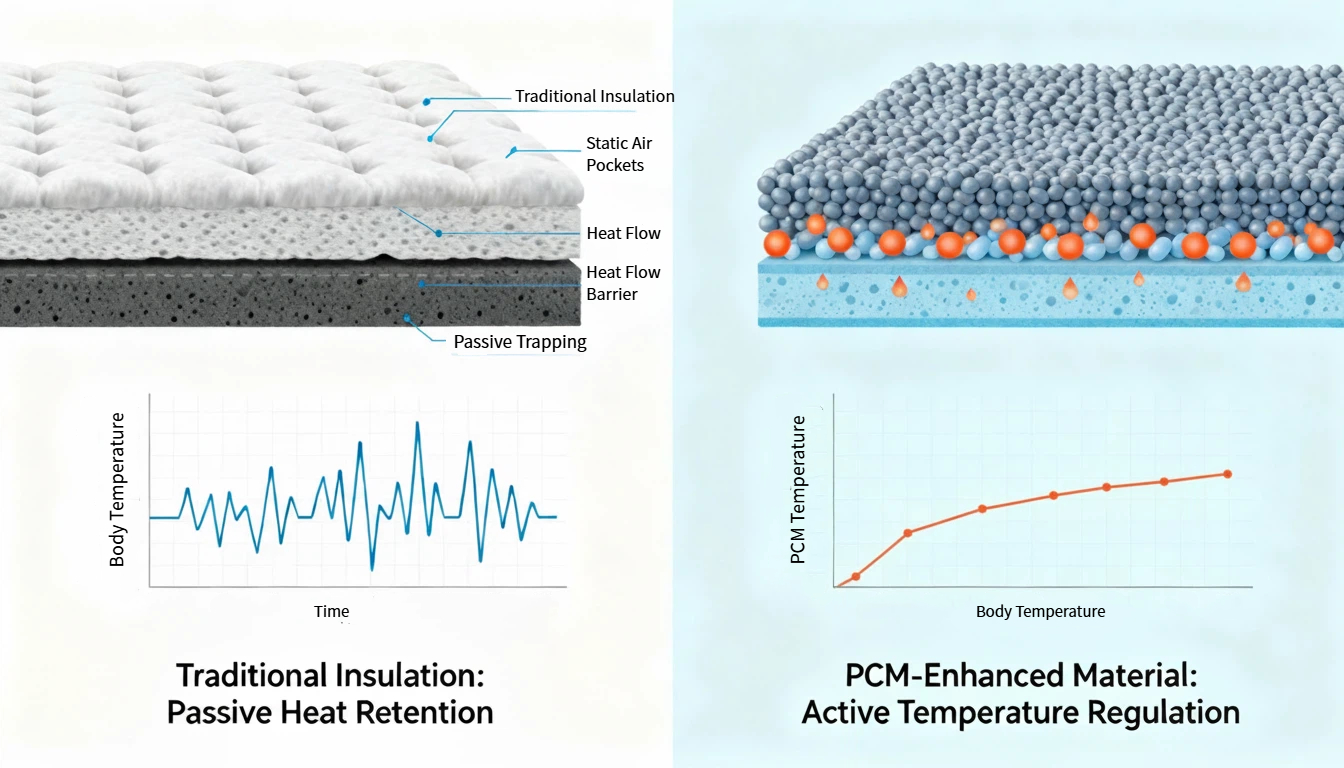
Phase change material’s functionality is rooted in its ability to bridge the gap between passive insulation and active climate control. Traditional fabrics rely on layers to trap air, which slows heat transfer but cannot adjust to sudden temperature changes. In contrast, phase change material proactively responds to thermal shifts, ensuring the user remains within a comfortable temperature range regardless of external conditions. This makes it ideal for applications where temperature stability is critical, from clothing and bedding to healthcare and automotive products.
The Scientific Mechanism Behind Phase Change Material
The working principle of phase change material is grounded in basic physics, with its origins tracing back to aerospace innovation. NASA first pioneered the use of phase change material in astronaut suits to combat the extreme temperature swings of space—where temperatures can oscillate between 120°C in sunlight and -150°C in shadow. Early iterations used microencapsulated natural waxes, such as those derived from rapeseed oil, which proved effective at stabilizing temperatures in harsh environments. This technology has since been adapted for terrestrial use, with modern engineering refining its performance for everyday applications.
IGO Textile has elevated the scientific foundation of phase change material through precision calibration and advanced encapsulation. The company’s phase change material is engineered to operate within a targeted temperature range: initiating a cooling phase change at 19°C (absorbing heat as it melts) and a warming phase change at 29°C (releasing heat as it solidifies). This calibration ensures the material responds precisely to the body’s needs, providing a perceptible cooling effect of 3-5°C in summer and sustained warmth in winter. A key breakthrough in IGO’s design is its nano-scale three-dimensional encapsulation process. Unlike traditional methods that coat fabric surfaces with phase change material microcapsules (which risk wear and leakage over time), IGO embeds the material directly into the fiber structure during melt-spinning. This integration locks phase change material within the yarn matrix, enhancing durability—even after countless washes—and ensuring uniform heat distribution across the entire fabric.
The mechanism of phase change material is both simple and effective. When the user’s body temperature rises, the heat melts the microencapsulated wax in the phase change material. According to physical laws, temperature cannot increase during a phase transition, so the excess thermal energy is absorbed by the material, keeping the body cool. Conversely, when the body cools down, the wax solidifies, releasing the stored thermal energy back to the user. This process repeats continuously, maintaining a stable temperature without any active effort from the user. IGO Textile’s engineering further optimizes this mechanism by increasing the active area of heat absorption, ensuring the phase change material responds quickly and evenly to temperature changes.

Technological Advancements: IGO Textile’s Innovative Approach
While phase change material has been around for decades, recent technological advancements have addressed its historical limitations—such as limited durability, uneven heat distribution, and environmental impact. IGO Textile has been at the forefront of these innovations, redefining phase change material for modern use through a combination of scientific rigor and sustainable design.
One of the most significant advancements is IGO’s integration of SEAQUAL® YARN, a premium raw material derived from upcycled marine plastic. For every meter of phase change material fabric produced, plastic waste is removed from oceans and transformed into high-performance textile fibers, turning a global environmental problem into a solution. This commitment to sustainability aligns with the growing demand for eco-conscious products, as consumers increasingly prioritize brands that minimize their environmental footprint. Additionally, IGO’s phase change material adheres to strict environmental standards, including OEKO-TEX® STANDARD 100 certification, and some products meet the stricter OEKO-TEX® MADE IN GREEN requirements.
Another key advancement is IGO’s focus on multi-functional integration. Phase change material is often combined with other advanced textile technologies to enhance its performance. For example, pairing phase change material with moisture-wicking fibers creates fabrics that reduce sweat production—by cooling the skin and drawing away excess moisture. This synergy makes phase change material ideal for high-performance activewear, where athletes need both temperature control and moisture management during intense activity. IGO’s phase change material is also compatible with antimicrobial treatments, adding hygiene benefits to its core functionality.
Durability is another area where IGO Textile has made significant strides. Traditional phase change material coatings can degrade over time, losing their thermoregulatory properties after repeated washes. IGO’s fiber-embedded phase change material, however, retains its functionality throughout the entire service life of the product, ensuring long-lasting performance. This durability makes phase change material suitable for everyday use, from clothing and bedding to frequently used items like automotive seats and medical cushions.


Diverse Applications of Phase Change Material
Phase change material’s versatility has made it a valuable component in a wide range of products across industries. Its ability to maintain temperature stability and enhance comfort has led to its adoption in apparel, home textiles, healthcare, automotive, and beyond.
In the apparel industry, phase change material is used in high-performance activewear, everyday clothing, and specialized garments. For example, running shirts infused with IGO’s phase change material keep athletes cool during workouts and warm during cool-downs, reducing sweat production and enhancing performance. Everyday clothing, such as t-shirts and sweaters, benefits from phase change material’s year-round comfort—keeping wearers cool in summer and warm in winter without adding bulk. Specialized garments, such as Islamic robes and uniforms, also leverage phase change material to provide comfort in diverse climates and working conditions.
Home textiles are another major application area for phase change material. Bedding and blankets infused with phase change material adapt to nighttime body temperature fluctuations, preventing overheating and reducing sweat production for a more restful sleep. Luxury home textiles, such as pillows and throws, use phase change material to enhance comfort, making them a popular choice for consumers seeking a higher quality of life.
In healthcare, phase change material is used in patient gowns, wheelchairs cushions, and recovery garments to maintain stable body temperatures for sensitive individuals, such as the elderly or post-surgical patients. This helps improve comfort and aids in the recovery process by reducing the stress of temperature fluctuations on the body. Medical seats and support bandages also incorporate phase change material to enhance patient comfort during long periods of use.
The automotive industry has also embraced phase change material for interior components. Seats and door panels integrated with phase change material reduce heat buildup in summer and retain warmth in winter, decreasing reliance on air conditioning and heating systems. This not only improves passenger comfort but also enhances fuel efficiency by reducing the load on the vehicle’s climate control system.
The Consumer and Environmental Benefits of Phase Change Material
Phase change material offers a range of benefits to consumers, including enhanced comfort, improved hygiene, and long-lasting performance. By maintaining a stable temperature, phase change material reduces sweat production, creating a more hygienic environment and reducing the risk of odor. Its proactive temperature regulation also prevents discomfort from overheating or chilling, making it ideal for use in diverse climates and activities. Additionally, the durability of modern phase change material ensures that products retain their functionality for years, providing consumers with long-term value.
From an environmental perspective, phase change material contributes to sustainability in multiple ways. IGO Textile’s use of SEAQUAL® YARN helps reduce marine plastic pollution, turning waste into a valuable resource. The material’s durability also reduces the need for frequent replacement, minimizing the environmental impact of fast fashion and disposable products. Furthermore, phase change material’s energy efficiency—reducing reliance on heating and cooling systems in automotive and construction applications—helps lower carbon emissions, contributing to a more sustainable future.
Conclusion: The Future of Phase Change Material
Phase change material has come a long way from its aerospace origins, evolving into a versatile, sustainable, and high-performance technology that enhances comfort and functionality across industries. With brands like IGO Textile leading the way in innovation, phase change material has addressed historical limitations and expanded its applications, making it a cornerstone of modern smart textiles. Its ability to actively regulate temperature, combined with its sustainability and durability, positions phase change material as a key solution for meeting the growing demand for comfortable, eco-conscious products.
As technology continues to advance, phase change material is expected to play an even greater role in shaping the future of textiles and beyond. From advanced activewear to smart home textiles and medical innovations, phase change material’s versatility and performance make it a valuable asset for brands and consumers alike. With its commitment to science, sustainability, and user-centric design, phase change material is set to redefine comfort and environmental responsibility for years to come. Whether in everyday clothing, healthcare products, or automotive interiors, phase change material proves that innovative technology can enhance lives while protecting the planet.

video of smart textile fabric
IGO vs. Outlast: Temperature Regulating Thermoregulation Fabric & Smart Textile Fabric Comparison


