
IGO TEXTILE vs. POLARTEC: The Battle of Thermal Mass vs. Thermal Intelligence

When discussing thermal regulation, two names often come up: the established giant POLARTEC and the innovative newcomer IGO TEXTILE.
A common question I receive is: "Aren't they both for keeping warm? What's the difference?"
Here is my professional breakdown:
1. POLARTEC: The Master of "Trapped Heat"
-
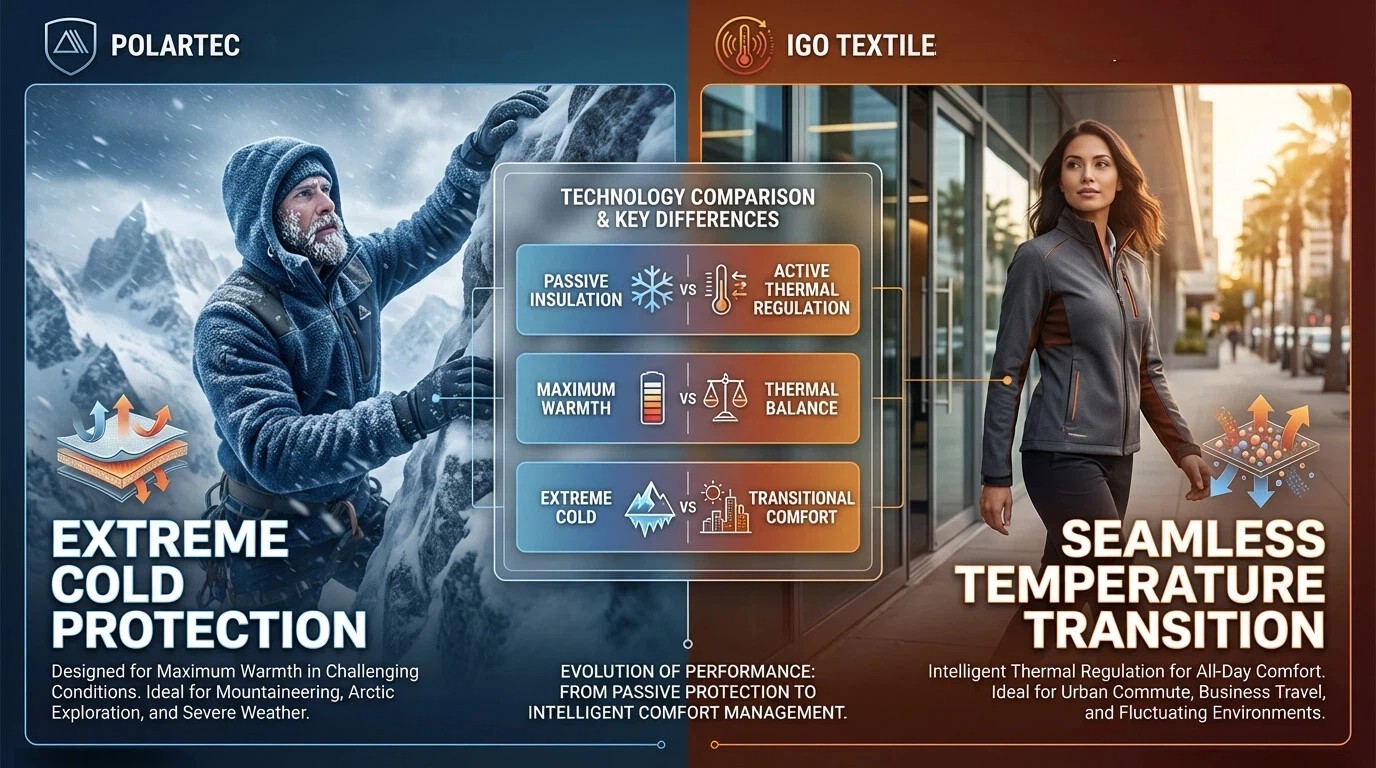
Mechanism: It works by trapping dead air (in fleece) or mechanically pumping moisture (in base layers).
-
Strengths: Unmatched warmth-to-weight ratio, softness, and durability. It's the gold standard for insulation.
-
Weakness: It's reactive. If you overheat, the trapped air becomes an oven. If you stop moving, condensation can make you cold. It creates a barrier, but doesn't buffer temperature swings.
2. IGO TEXTILE: The Architect of "Thermal Balance"
-
Mechanism: Utilizes Phase Change Materials (PCM) to absorb excess body heat before it makes you sweat, and releases it when you cool down.
-
Strengths: Eliminates Thermal Shock. It doesn't just insulate; it stabilizes. It acts like a thermal battery, smoothing out the peaks and valleys of your body temperature.
-
Weakness: In extreme static cold (-20°C), a thin layer of IGO fabric won't replace the brute warmth of a POLARTEC 300 jacket.
-
Best Use: Urban wear, business travel, and activities involving frequent transitions (e.g., in/out of cars, buildings).
My Recommendation:
For extreme outdoor sports or where maximum loft and warmth are critical, stick with POLARTEC.
For lifestyle, business, or transitional wear where comfort across varying temperatures is key, IGO TEXTILE offers a unique competitive edge.
The future of comfort isn't just about being warm; it's about being consistently comfortable.
Textile-to-Textile: The Closed-Loop Revolution – Is Your Brand Ready?
COOLMAX vs. IGO TEXTILE: Choosing Between Moisture Management and Thermal Buffering


